
Carboxylic acids and derivatives


Medchemexpress LLC SPD-473 citrate | 161190-26-7 | MFCD31382144 | 99.8% | 552.47 g/mol | C23H31Cl2NO8S | 1 MG

SPD-473 citrate is the citrate salt of a triple reuptake inhibitor that blocks serotonin, dopamine, and norepinephrine transporters. Supplied for research use, it is a characterized white to off-white solid with documented purity and solubility data for in vitro and in vivo studies.
- Acts as a serotonin, dopamine, and norepinephrine reuptake inhibitor.
- High purity (99.8%).
- Molecular weight 552.47 g/mol.
- White to off-white solid suitable for laboratory handling.
- High solubility in DMSO (100 mg/mL); in vivo formulation protocols provided.
- Available in 1 mg, 5 mg, 10 mg, and 25 mg pack sizes for screening and pilot studies.

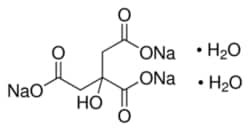
Sigma Aldrich Fine Chemicals Biosciences Sodium citrate tribasic dihydrate BioUltra, for molecular biology | 6132-04-3 | MFCD00150031 | 250g
Sodium citrate tribasic dihydrate BioUltra, for molecular biology | 99.5% | MW: 294.1 | 6132-04-3 | MFCD00150031 | 250g


Medchemexpress LLC Cyclic GMP-AMP diammonium | 96.6% | 708.47 g/mol | C20H30N12O13P2 | 5 MG
cGAMP diammonium is a cyclic dinucleotide that functions as an endogenous second messenger and a potent activator of the stimulator of interferon genes (STING) pathway. Provided as the diammonium salt for research use, it induces type I interferon production and is used to study innate immune signaling.
- Activates STING and triggers type I interferon signaling.
- High purity (96.6%) suitable for research applications.
- Molecular formula C20H30N12O13P2; molecular weight 708.47 g/mol.
- Water-soluble; dissolves up to 100 mg/mL with ultrasonic assistance.
- Solid storage recommended at -20°C; solution storage guidance provided.
- Supplied in small quantities (e.g., 5 mg) for laboratory use.
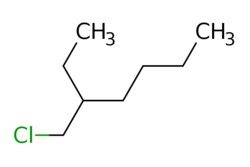
eMolecules 123-04-6 | 3-(Chloromethyl)heptane | Ambeed | MFCD00018940 | 148.670 | C8H17Cl | 98.000 | CCCCC(CC)CCl | 25g | 599120951
3-(Chloromethyl)heptane | Ambeed | 123-04-6 | MFCD00018940 | 148.670 | C8H17Cl | 98.000 | CCCCC(CC)CCl | 25g | 599120951
Medchemexpress LLC ζ-Stat trisodium (NSC37044 trisodium) | 31894-34-5 | 97.0% | 450.31 | C10H5Na3O10S3 | 50MG
ζ-Stat trisodium is a small-molecule inhibitor of protein kinase C zeta (PKC-ζ) used in biochemical and cellular research. It is supplied as a light yellow to light brown solid with a reported purity of 97.0%, molecular formula C10H5Na3O10S3, and molecular weight 450.31 g/mol. The compound is typically provided in small, preweighed quantities suitable for laboratory studies.
- Inhibits protein kinase C zeta (PKC-ζ) activity.
- CAS number 31894-34-5.
- Purity 97.0%.
- Molecular formula C10H5Na3O10S3; molecular weight 450.31 g/mol.
- Solid, light yellow to light brown appearance.
- Available in multiple small research quantities (mg scale).
Sigma Aldrich Fine Chemicals Biosciences Tris(2-carboxyethyl)phosphine hydrochloride BioUltra, >=98% (NMR) | 51805-45-9 | MFCD00145469 | 10G
Tris(2-carboxyethyl)phosphine hydrochloride BioUltra, >=98% (NMR) | Purity: >=98% (NMR) | Mol Wt: 286.65 | 51805-45-9 | MFCD00145469 | 10G
Medchemexpress LLC Arimoclomol citrate 5mg | 368860-21-3 | 5MG
Arimoclomol citrate (BRX-220 citrate) is an orally active co-inducer of heat shock proteins (HSP)[1 Arimoclomol citrate protects motor neurons by enhancing Hsp expression thus directly affecting protein aggregation and clearance of misfolded assemblies via the proteasome-ubiquitin system[2 Arimoclomol citrate can be used for the study of Niemann Pick disease type C
Medchemexpress LLC Azido-PEG6-CH2COOH | 880129-82-8 | ≥98.0% | 365.38 | 1 G
Azido-PEG6-CH2COOH is a PEG-based PROTAC linker used in the synthesis of PROTACs. It is a click chemistry reagent, featuring an azide group for copper-catalyzed azide-alkyne cycloaddition (CuAAc) reactions with alkyne-containing molecules. It also facilitates strain-promoted alkyne-azide cycloaddition (SPAAC) reactions with DBCO or BCN groups.
- Functions as a PEG-based PROTAC linker
- Used in the synthesis of PROTACs
- Acts as a click chemistry reagent
- Enables copper-catalyzed azide-alkyne cycloaddition (CuAAc) reactions
- Supports strain-promoted alkyne-azide cycloaddition (SPAAC) reactions
- Integral to PROTACs that selectively degrade target proteins